
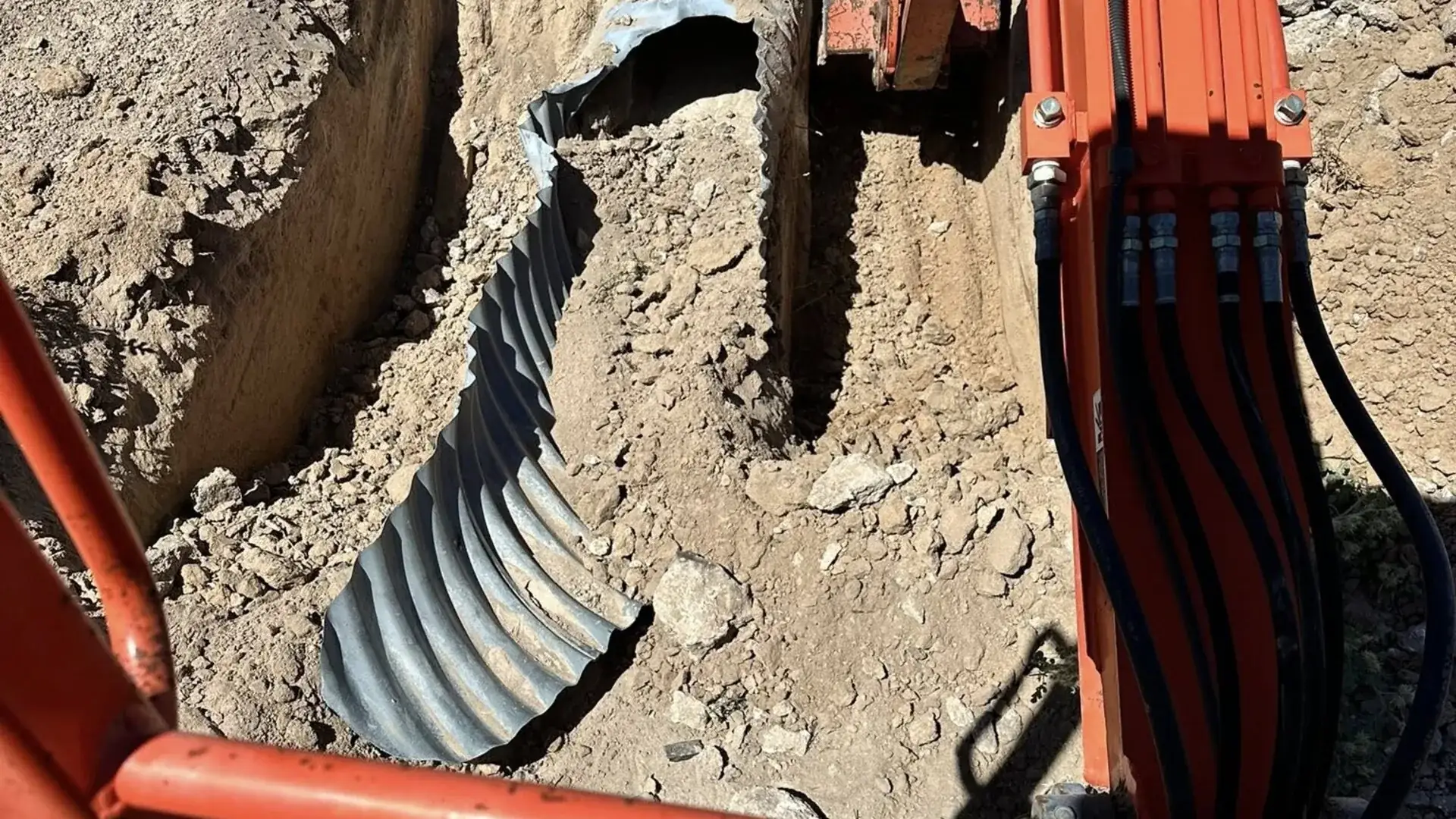
A driveway culvert has one job: carry the water in the roadside ditch under your driveway instead of over it. Get the size right and your approach shrugs off the next gully-washer. Get it wrong and you are looking at a washed-out entrance, a flooded ditch, or a county inspector asking you to redo the work. Here is how we size driveway culverts for properties across Canyon, Amarillo and the wider Texas Panhandle.
What actually determines culvert size
The right diameter is not a guess. It comes down to a few things:
- The drainage area upstream. How much land sheds water into the ditch that runs past your driveway? A short residential lot moves a lot less water than a quarter-section of pasture draining toward a bar ditch.
- Ditch depth and slope. A deep, fast ditch needs a pipe that can keep up. A shallow, flat ditch backs up more easily, so the pipe has to be sized generously.
- Local and county requirements. Many counties set a minimum culvert diameter for a new approach (often 18 inches) and want the ends set back from the road. We check the local rules before we dig.
- Driveway width. A wider approach needs a longer pipe, and sometimes a second joint, to reach daylight on both sides.
Common driveway culvert sizes
For most single-home driveways in the Panhandle we install 15-inch, 18-inch, or 24-inch corrugated metal or HDPE pipe. As a rough rule of thumb:
- 15 inch works for a short driveway with a small, shallow ditch and very little upstream drainage.
- 18 inch is the workhorse size and a common county minimum for a new approach.
- 24 inch and up is for wider drainage areas, deeper ditches, ranch and field entrances, or anywhere water really moves in a heavy rain.
When in doubt, we size up. The cost difference between an 18 and a 24 is small compared to rebuilding a driveway that washed out.
Installing it so it lasts
Sizing is only half the job. A culvert that is set too high dams the ditch; set too low it silts up. We grade the pipe to match the flow line of the ditch, bed it on compacted material, and backfill and compact in lifts so the driveway does not settle over the top. On entrances that take a hard hit from runoff we add flared ends or rip-rap rock so the inlet and outlet do not scour out. This is where our culvert installation and driveway construction work go hand in hand.
Signs your culvert is too small
If you already have a culvert, watch for these red flags after a big rain: water standing in the ditch on the upstream side, water running over your driveway instead of through the pipe, or erosion cutting in around the ends. Any of those means the pipe cannot pass the flow and it is time to upsize.
Let us size it for you
Every entrance is a little different, so we walk the site, look at the ditch and the drainage above it, and check the local rules before we quote a number. If you are planning a new driveway or fighting a culvert that keeps washing out, reach out for a free estimate and we will get you the right pipe, set the right way.